

The Golden Temple travel guide begins with an important clarification: the shrine commonly called the Golden Temple is formally known as Sri Harmandir Sahib, also called Sri Darbar Sahib. It is the central religious shrine of Sikhism and stands in the heart of Amritsar, Punjab.
The golden structure surrounded by the Amrit Sarovar is instantly recognisable, but the experience is much deeper than its appearance. The complex combines prayer, music, architecture, history, community service and hospitality. The SGPC describes Sri Harmandir Sahib as a central Sikh religious site visited daily by devotees from India and around the world.
This Golden Temple travel guide explains what first-time visitors should know, from the history and architecture to etiquette, langar, nearby attractions and practical planning.
This post contains affiliate links. If you choose to book through them, a small commission may be earned at no additional cost to you. Your support genuinely helps keep the blog running and allows continued creation of high-quality travel guides. Thank you for being here and supporting this journey.
Also Read – Best Places to Visit in Amritsar: A Complete Travel Guide to Punjab’s Spiritual Heart
Why Visit the Golden Temple?
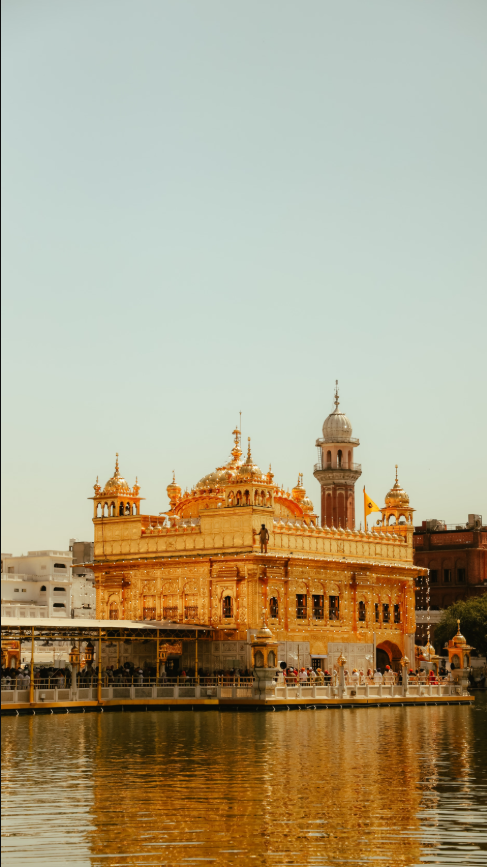
A major reason to follow a Golden Temple travel guide rather than simply treating the shrine as another sightseeing attraction is that Sri Harmandir Sahib remains an active place of worship.
The complex is open to people of all backgrounds. Its four entrances symbolise accessibility from all directions, while the temple’s lower position relative to the surrounding ground reflects an emphasis on humility. The SGPC specifically explains that the design was intended to communicate equality and accessibility without distinction of caste, creed, sex or religion.
Visitors can listen to Gurbani and kirtan, walk around the Amrit Sarovar, observe the architecture and experience the communal langar.
A respectful Golden Temple travel guide therefore needs to focus as much on behaviour and atmosphere as on sightseeing.
History of the Golden Temple
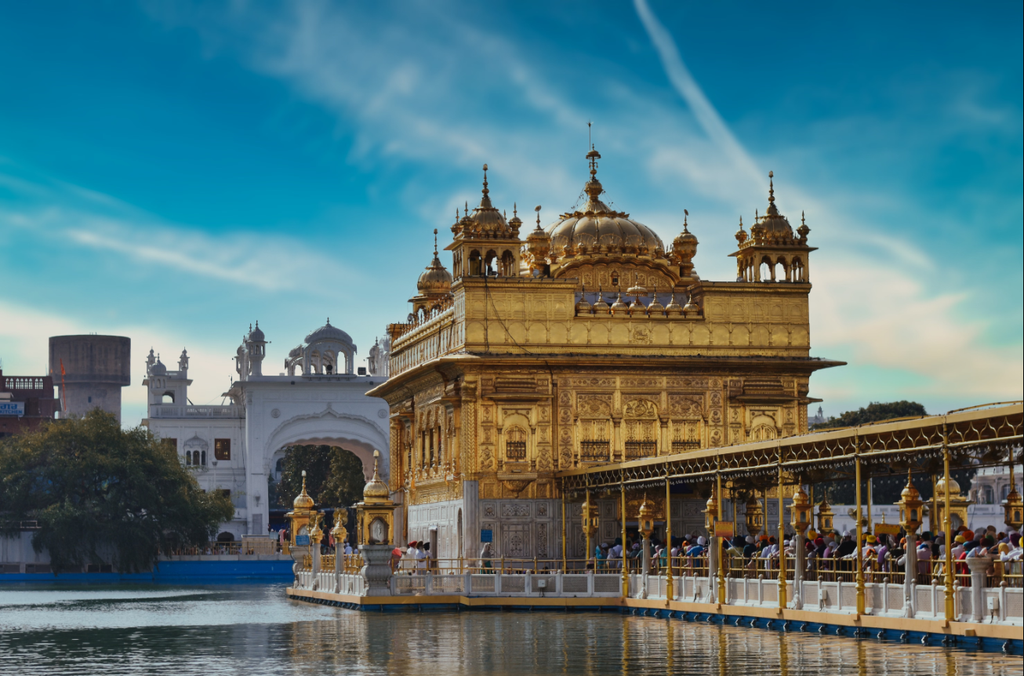
Understanding the history adds considerably more meaning to a Golden Temple travel guide.
The development of Amritsar and the sacred pool began during the period of Guru Ram Das. According to the SGPC, work on the Amrit Sarovar and the settlement began around 1570, with the Sarovar completed in 1577. Guru Arjan Sahib subsequently developed the Harmandir Sahib and had its foundation laid in December 1588.
The construction was completed in 1601. In 1604, the Adi Granth was installed at Harmandir Sahib, with Baba Buddha Ji appointed as the first Granthi.
The shrine experienced repeated destruction and reconstruction during periods of conflict. The SGPC records attacks and demolitions during the eighteenth century, followed by reconstruction. Maharaja Ranjit Singh later contributed significantly to the shrine’s development, including gold plating associated with the central structure.
This history explains why the complex is simultaneously a place of devotion, historical memory and Sikh identity.
Golden Temple Architecture
Architecture is one of the most compelling reasons to include detailed architectural information in a Golden Temple travel guide.
Sri Harmandir Sahib stands in the centre of the Amrit Sarovar and is connected to the surrounding complex by a causeway. The SGPC records that the temple itself is approximately 40.5 feet square and has entrances on all four sides.
The combination of marble, decorative inlay, gilded surfaces, domes and intricate ornamentation produces the visual effect visitors associate with the Golden Temple.
Yet the most striking architectural feature may be its relationship with water. The golden building appears to float above the Sarovar, particularly during early morning or after sunset when reflections become visible.
The Golden Temple travel guide experience is therefore best approached slowly. Walk around the Parikrama before concentrating on the central shrine.
The Amrit Sarovar
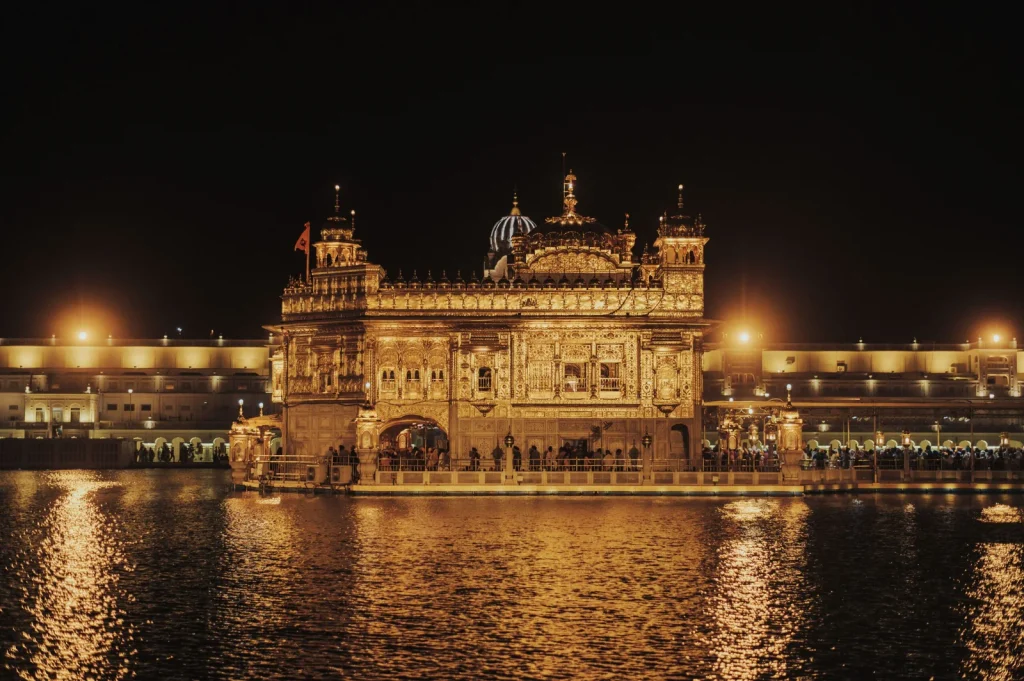
The Amrit Sarovar is the sacred pool surrounding Sri Harmandir Sahib and is central to the identity of the complex.
Walking around the Sarovar is one of the simplest ways to experience the site. From different points along the Parikrama, visitors see changing perspectives of the central shrine, causeway, surrounding buildings and Akal Takht.
The SGPC notes that the water system has undergone cleaning and restoration through periods of kar seva.
For photographers, reflections in the Sarovar can be particularly impressive, but photography should never interfere with worshippers or religious activity.
Akal Takht Sahib
No Golden Temple travel guide would be complete without explaining the Akal Takht.
Located opposite Sri Harmandir Sahib, Akal Takht Sahib was established by Guru Hargobind. The SGPC describes it as a major centre of Sikh authority and records its construction beginning in 1606.
The physical relationship between Akal Takht and Harmandir Sahib is significant. Visitors can therefore understand the complex more completely by visiting both rather than focusing exclusively on the golden shrine.
Allow enough time to observe the buildings, listen to explanations where available and appreciate their different historical roles.
Golden Temple Langar
One of the most memorable elements of a Golden Temple travel guide is the langar.
The communal kitchen provides free meals to visitors regardless of background. Langar expresses principles of equality, service and community participation.
Visitors can participate respectfully by following the instructions of volunteers and sitting with other diners. The experience is not a restaurant visit; it is an expression of Sikh hospitality and seva.
The scale of the operation is particularly striking because the system depends heavily on volunteers and donations.
If you have time, observing or participating in seva can provide a deeper understanding of the community culture surrounding Sri Harmandir Sahib.
Golden Temple Dress Code
Following the correct etiquette is essential when using a Golden Temple travel guide.
Visitors should dress modestly and cover their heads before entering the sacred complex. A head covering is required, and scarves are commonly available for visitors who need one.
Shoes must be removed before entering the relevant areas, and visitors pass through designated foot-washing facilities before proceeding into the complex.
Avoid clothing that is excessively revealing, and remember that this is a functioning place of worship.
Mobile phones should be used discreetly. Loud conversations, disruptive photography or behaviour that interferes with prayer should be avoided.
Best Time to Visit
The best timing depends on the experience you want.
Early morning can be particularly atmospheric because the complex is quieter and the light over the Sarovar can be beautiful. Evening provides another distinctive experience as the illuminated shrine reflects across the water.
For comfortable sightseeing around Amritsar, the cooler months from October to March are generally easier than the intense summer period.
Winter mornings can be chilly, so carry a light jacket. Summer afternoons can become very hot, making early morning and evening visits more comfortable.
Festivals and major religious occasions can create exceptionally busy conditions. These periods can be spiritually significant but require additional patience and planning.
How Long Do You Need?
A practical Golden Temple travel guide should allow more time than simply visiting the shrine, taking photographs and leaving.
Allow at least 3–4 hours for a meaningful first visit. This gives you time to enter the complex, walk around the Sarovar, visit Sri Harmandir Sahib, see Akal Takht and experience langar.
A full day is preferable if you want to explore the wider historic complex carefully.
Visitors with two days in Amritsar can combine the Golden Temple with Jallianwala Bagh, Partition Museum, local markets and the Wagah–Attari border area.
Nearby Attractions
The Golden Temple’s location makes it easy to build a broader Amritsar itinerary.
Jallianwala Bagh is located close to the complex and is an important site associated with the 1919 massacre during British colonial rule.
The Partition Museum provides historical material relating to the Partition of India and its human consequences.
The old city markets around Hall Bazaar and Heritage Street provide opportunities to experience local food, textiles, religious items and traditional shopping.
For a longer outing, the Attari–Wagah border is accessible from Amritsar, although visitors should check current arrangements and timings before travelling.
How to Reach the Golden Temple
Location is another reason the Golden Temple travel guide is useful for first-time visitors.
The shrine is in central Amritsar. The SGPC states that Sri Harmandir Sahib is approximately 3 kilometres from Amritsar railway station, around 1.5 kilometres from the interstate bus stand and approximately 20 kilometres from Sri Guru Ram Dass Jee International Airport.
The railway station connects Amritsar with major Indian cities, while the airport provides domestic and international connections.
The SGPC also states that free bus services are provided between the railway station, bus stand and Harmandir Sahib for visitors.
Within the city, auto-rickshaws, taxis and app-based transport can be useful, although walking is often practical around the old city.
Golden Temple Photography Tips
Photography is an important part of many visits, but a good Golden Temple travel guide should emphasise respectful photography.
The most visually compelling perspectives often come from the Parikrama rather than directly in front of the shrine.
Early morning provides soft light, while after sunset the illuminated building creates strong reflections in the Sarovar.
Avoid photographing people in intimate moments of prayer without permission. Follow any signs or instructions regarding restricted photography.
The objective should be to document the architecture and atmosphere without turning a place of worship into a conventional photo set.
What to Eat in Amritsar
Your Golden Temple travel guide should also include the city’s food culture.
Beyond langar, Amritsar is famous for Punjabi cuisine. Visitors can try Amritsari kulcha, chole, lassi, paneer dishes and other regional specialities.
The old city contains numerous food establishments, ranging from traditional eateries to modern restaurants.
Try local food after visiting the shrine rather than treating the langar as simply a free meal. Langar is fundamentally an act of community service and should be approached respectfully.
Golden Temple Travel Tips
Keep these points in mind when planning your visit:
- Cover your head before entering.
- Remove shoes as required.
- Dress modestly.
- Wash your feet before entering the sacred areas.
- Keep your voice low.
- Follow instructions from volunteers and security personnel.
- Do not disturb people engaged in prayer.
- Allow additional time during major religious occasions.
- Carry water, particularly during warmer months.
- Keep valuables secure in crowded areas.
- Avoid treating the complex purely as a photography location.
- Consider participating respectfully in langar or seva.
A Suggested One-Day Amritsar Itinerary
A practical Golden Temple travel guide itinerary could begin with an early morning visit to Sri Harmandir Sahib.
Spend several hours around the complex, including time for the Sarovar, Akal Takht and langar.
After breakfast or lunch, visit Jallianwala Bagh and the Partition Museum.
Spend the late afternoon exploring the old city and local markets.
If your schedule permits and current timings allow, travel towards the Attari–Wagah border in the afternoon.
Return to Amritsar for an evening meal and, if energy allows, experience the Golden Temple after dark. Seeing the illuminated shrine reflected in the Sarovar offers a very different atmosphere from the morning visit.
Final Thoughts
A good Golden Temple travel guide should do more than explain how to reach Amritsar. Sri Harmandir Sahib is a place where architecture, spirituality, history and community service exist together.
The shrine’s four entrances express accessibility, the surrounding Sarovar creates a powerful visual setting, and the langar demonstrates a living tradition of communal service. The nearby Akal Takht adds another essential historical dimension.
For first-time visitors, the most rewarding approach is to slow down. Walk around the Sarovar, listen to the kirtan, observe the architecture, visit Akal Takht and experience the langar respectfully.
Use this Golden Temple travel guide as a framework rather than a checklist. Leave room for the atmosphere of the complex to shape your visit.
The Golden Temple is undoubtedly one of India’s most recognisable landmarks, but its significance cannot be reduced to its golden exterior. It is a living religious institution, a historic centre and a place where visitors from different backgrounds are welcomed.
That is what makes the Golden Temple travel guide experience so distinctive: the most memorable part of the journey is often not simply seeing the monument, but understanding the traditions, history and values that give the place its meaning.

